Key takeaways
- Domestic Japanese moves from postcode and prefecture toward the room
- Romanized international output commonly begins with recipient and specific location
- The seven-digit postcode is commonly displayed as 123-4567
- Translation, romanization, and validation are separate operations
Authorship and review
Read our editorial and review principles- Written by
- Random Address Generator Editorial Team
- Reviewed by
- International Address Format Review Team
- Latest substantive update
- Reviewed opposite Japanese and Romanized address orders, seven-digit postcodes, and international-label character constraints.
Two orders, not a simple reversal
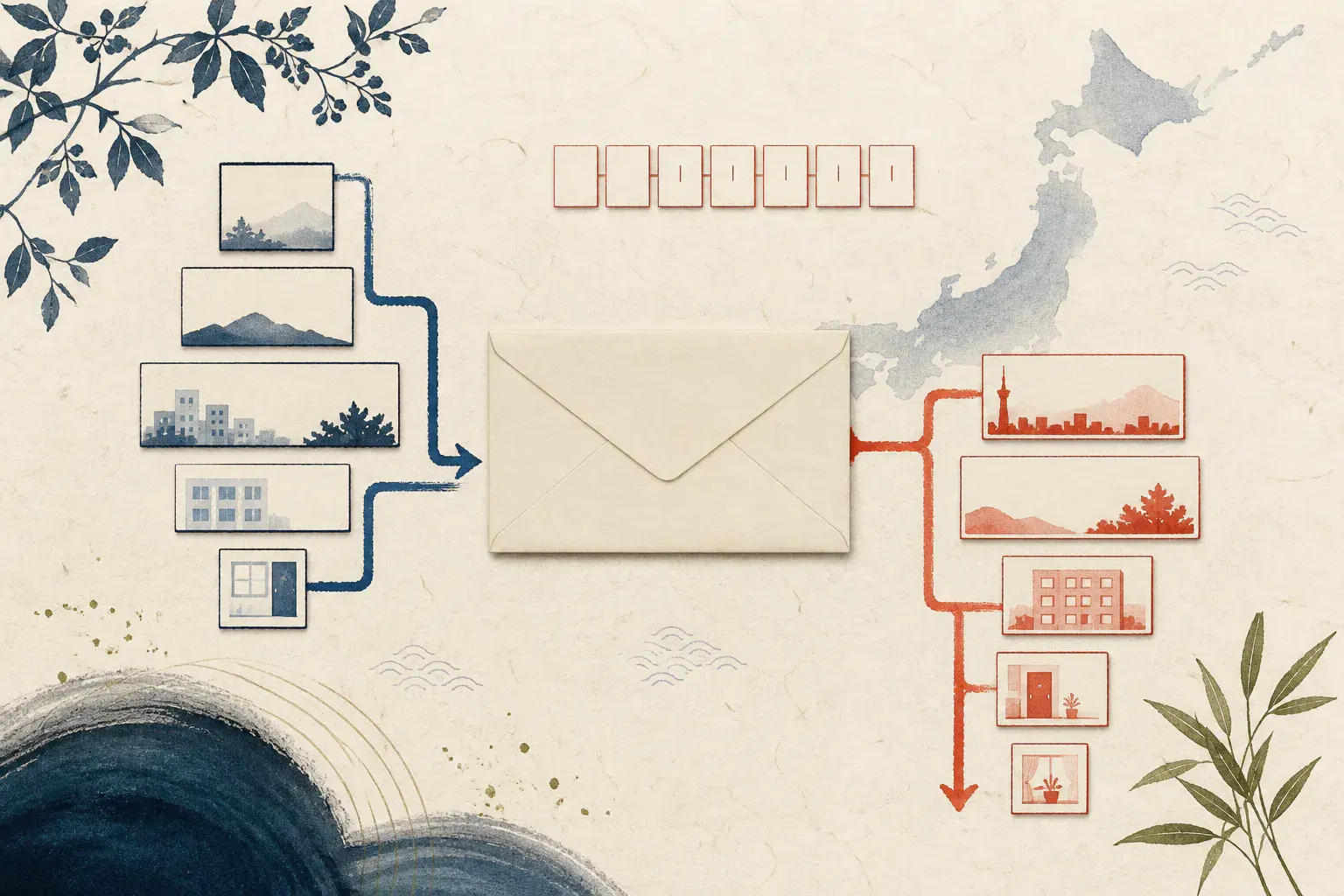
Domestic Japanese commonly moves from broad geography to specific location: postcode, prefecture, municipality, district and block, building and room, then recipient. Romanized international rendering typically begins with the recipient and specific premises.
Do not reverse raw strings. Parse meaningful prefecture, municipality, block, and building fields, then render for the target language.
Carrying Japanese data in international fields
Map prefecture to address-level1, municipality to address-level2, district and block to line 1, and building and room to line 2. Preserve the unparsed original for review and future parsing.
| Generic field | Japanese meaning | Example |
|---|---|---|
| postal-code | Seven-digit postcode | 100-0005 |
| address-level1 | Prefecture | Tokyo |
| address-level2 | Municipality or ward | Chiyoda-ku |
| address-line1 | District, chome, block | Marunouchi 2-4-1 |
| address-line2 | Building and room | Sample Building 501 |
Seven-digit postcode input and display
The usual display is three digits, hyphen, four digits. Store it as text to retain leading zeroes. A form may accept the postal mark, but should store it separately from the postcode value.
function normalizeJapanPostcode(value) {
  const digits = value.replace(/[^0-9]/g, '');
  return digits.length === 7 ? `${digits.slice(0, 3)}-${digits.slice(3)}` : value.trim();
}
Romanization is not lossless English translation
Store Japanese source text and a user-confirmed Romanized form separately. Names and buildings can have multiple established spellings, so avoid regenerating them on every render.
Japan Post label channels have character constraints. Test database acceptance separately from label-print acceptance.
Japanese regression fixtures
Include source Japanese, Romanized output, an empty building line, and a long building name. Synthetic data tests structure, not the existence of a particular block.
- Preserve postcode leading zeroes in CSV
- Define a policy for full-width digit input
- Store Japanese and Romanized values separately
- Allow an empty second line
- Never silently truncate a room number
Reviewing two output orders from one address record
Render both a domestic Japanese version and a Romanized international version from the same structured fixture. If the two views depend on unrelated raw strings, there is no reliable way to show that room, building, and block survived conversion. Instead, assert that each semantic component appears exactly once and then review the localized order.
Enter the postcode with a hyphen, without a hyphen, and with the postal mark. All three inputs can converge on one canonical display while retaining the raw value for diagnostics. Store digits as text so a leading zero cannot disappear between a spreadsheet fixture and the API.
Finally test the actual print channel. A database can preserve Japanese source text while a particular international label service imposes a narrower character set. Report that as a channel limitation rather than modifying the source address. The user-confirmed Romanized spelling should remain separate and reusable. Repeat the check whenever the carrier integration or label template version changes.
- Generate both orders from one structured record
- Assert that no semantic component is lost or duplicated
- Normalize multiple postcode input forms
- Verify character support in the real print channel
Frequently asked questions
Is English address order the reverse of Japanese?
Broadly, yes, but render parsed components rather than reversing lines or characters.
Should the postcode hyphen be stored?
You may store canonical 123-4567 or separate compact and display values. In either case, preserve leading zeroes.
Can I discard Japanese after romanization?
No. Romanization can vary, and retaining source text makes later review possible.